
The Only Thing You Actually Control
I spent years trying all the productivity hacks, the morning routines, and the goal-setting frameworks. I worked on my mindset, my habits, and my discipline day in and day out. But somehow, I still felt scattered.
Self-improvement felt like a full-time job.
Here’s what I finally realized: I wasn’t failing. I was just working on the wrong things first.
The typical approach to self-improvement is scattered. There’s no prioritisation or systematic improvements. We try to improve different parts of our life in isolation or as we encounter each piece of advice, as opposed to targeting the point of highest leverage. But our resources are finite. Time, mental energy, and physical capacity. We only have so much.
So the real question isn’t “How do I improve?”
It’s “What should I improve first?”
The answer lies in the thing that influences every decision you make. Not your habits or routines, but something deeper.
Your Only Lever
If you trace your actions, opinions, and desires back to their source, they all originate in one place — your misconcepts, the mental models you hold about how the world works.
In that sense, misconcepts aren’t just important. They’re the only lever you have.
“The only thing we truly control in life are our Misconcepts.”
Misconcepts are the root from which everything cascades. Your internal experience and external results are the outputs of your misconcepts.
As Marcus Aurelius understood: “If you are distressed by anything external, the pain is not due to the thing itself, but to your estimate of it; and this you have the power to revoke at any moment.”
Better Misconcepts -> Better interpretation of reality -> Better internal experience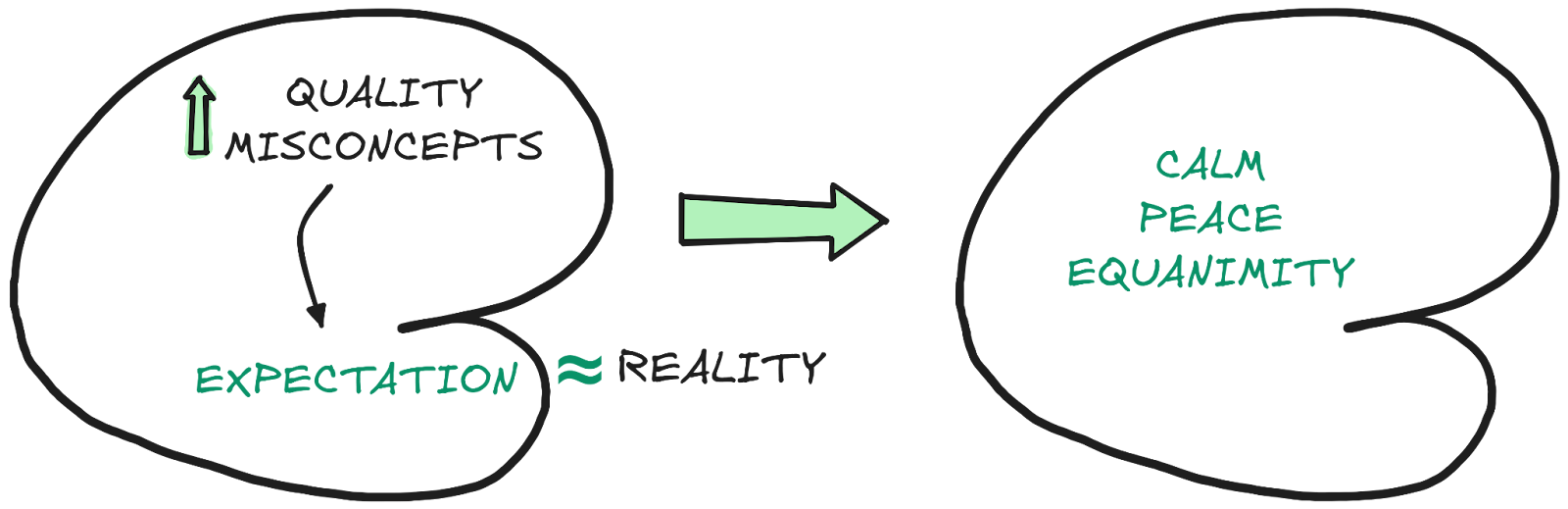
Better Misconcepts -> Better decisions -> Better actions -> Better external results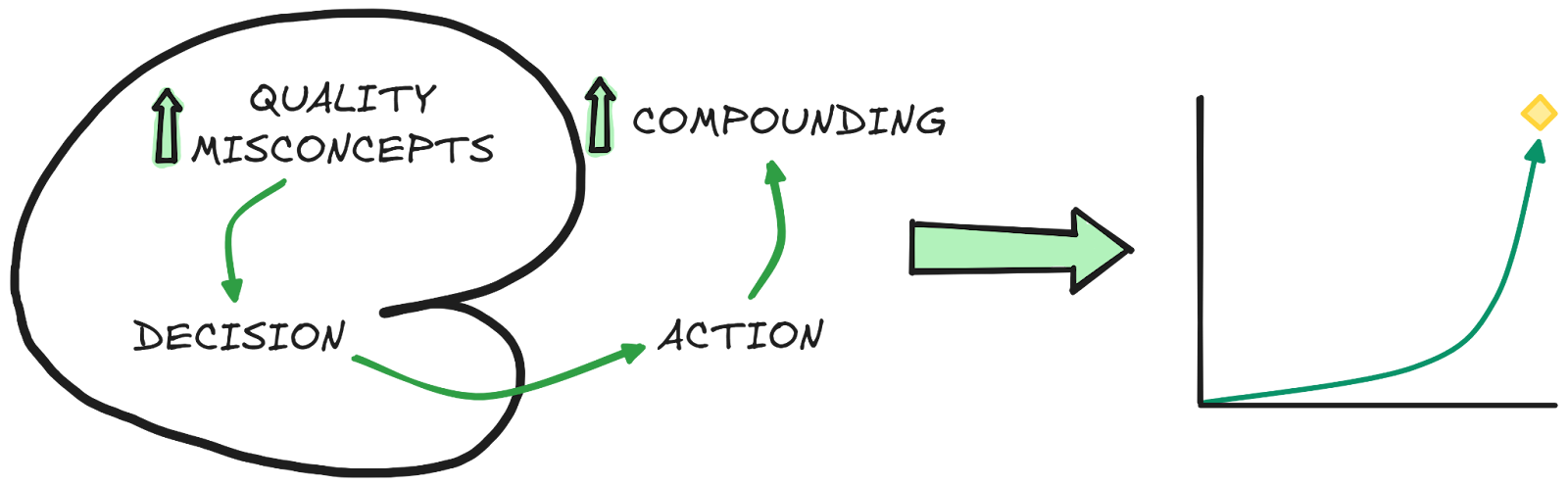
Your life isn’t just happening to you. It’s being built by the mental models you’re currently operating with.
“The mind is everything. What you think you become.” - Buddha
All Misconcepts Are Fallible
Here’s the catch: all misconcepts are fallible.
This is why we call them misconcepts — a deliberate reminder that our mental models are “wrong” in some sense, yet improvable through error-correction. This insight comes from Critical Rationalism, a theory that recognizes all knowledge is provisional.
We improve when we spot where our models clash with reality. As we spot these clashes and correct the errors, our misconcepts sharpen. They align more closely with reality. This compounds over time into better internal experiences and better external results.
Most people never do this systematically. They inherit their mental models from parents, education, community, and culture, then run their lives on autopilot. They never ask: Is this mental model still serving me? Where is it wrong? How could it be better?
The people who do systematically refine their misconcepts experience not just better results, but also more internal peace.
But this is where the problem emerges. You can’t refine all the misconcepts you need in life at the same time or equally. Your life resources are finite.
The Resource Constraint
Time. Mental energy. Physical capacity. Every choice consumes some of each, and you have a fixed amount.
This leads to an unavoidable reality: opportunity costs. Every choice means forgoing the next best alternative. If our resources are finite and opportunity costs exist, then where we invest our misconcept refinement efforts matter enormously.
So which mental models should you focus on first? Which misconcepts will give you the highest ROI on your finite resources?
The answer surprised me. It’s not your misconcepts about health, wealth, or relationships as you might imagine. Those matter greatly, but they’re branches, not the trunk.
The highest leverage lies in what we call high-level misconcepts — the mental models invoked in literally every decision you make. These have the greatest reach across all domains of life and thus disproportionately influences both your internal experience and external results.
Through our own journey of refining and testing these ideas, we’ve identified four high-level misconcepts that form the foundation of all decisions:
Misconcepts: Your understanding of mental models and how they work. Whether you believe they are fixed or improvable. This determines how and whether you’ll invest in refining them at all.
Life Resources: Your understanding of your finite time, mental energy, and physical capacity. This determines how you allocate them. Recognizing that life resources are finite makes opportunity costs unavoidable.
Arbitrary Life Goals: Your understanding of how life goals can be self-defined but generally start off inherited and never examined. This determines whether you make decisions that optimize for your own vision or someone else’s. Without clear self-defined life goals, we cannot meaningfully assess the ROI of our decisions, and risk optimizing for inherited or unclear priorities.
Opportunity Cost: Your understanding of the reality of tradeoffs, that every choice means forgoing the next best alternative. This determines whether you make decisions strategically or carelessly.
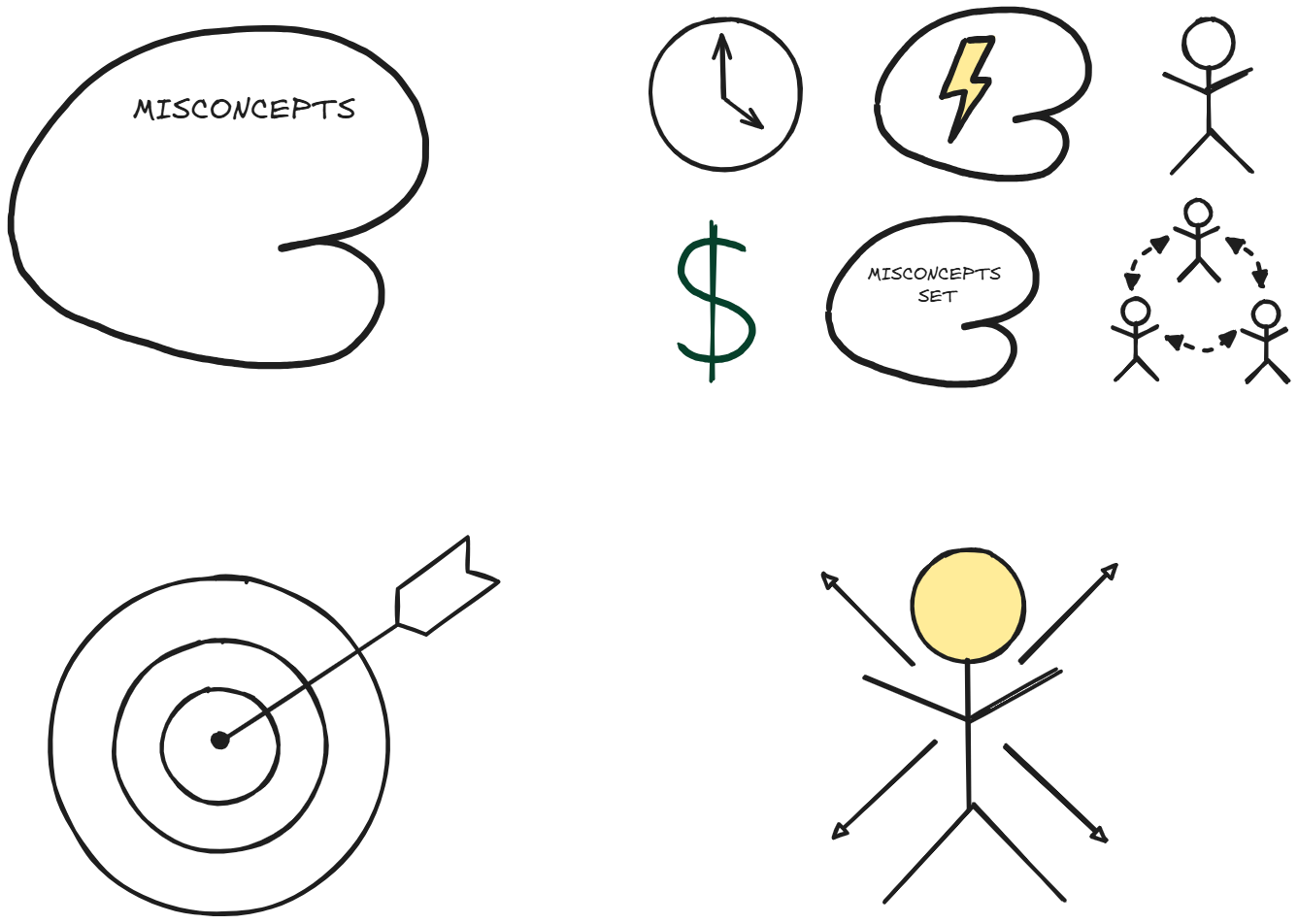
These four misconcepts are operating every time you make a decision, whether you’re aware of them or not. Their quality influences every downstream decision. Refine one, and you refine thousands of decisions that follow. Leave them unexamined, and you’re optimising with a broken system.
But how do you know which ones are fit-for-purpose and which ones need attention? Here’s a simple way to find out.
See Your Misconcepts In Action
Here’s how to see what you’re actually working with.
Think about the last thing you did. It doesn’t matter what — had a coffee, chatted with a friend, checked email, bought something, went for a walk.
Now ask yourself: “Can I fully justify this action?”
This simple question reveals something important: all your actions, even the mundane ones, are guided by your high-level misconcepts.
This isn’t about judgement. This is about discovering the underlying mechanisms through which you make your decisions and actions.
Let me walk you through an example from my own life:
The last thing I did this morning was have a cup of coffee. It was a home-brewed filter coffee using high-quality Panama Geisha beans purchased at a 60% clearance discount.
Short-term: From a physical resource perspective, I gained caffeine, a benefit that’s also achievable with much cheaper instant coffee. But I also gained mental resources from the satisfaction of making the coffee, savoring its nuanced notes, and enjoying it with my partner. This made the slightly higher time and financial cost worthwhile for me.
Long-term: There may be some cognitive or gut health benefits, but also the risk of caffeine dependence which could create a mental resource drain. Fortunately, neither outcome is expected to materially impact my arbitrary life goal of optimising life resources.
Opportunity costs: The time and money could have gone elsewhere. But when assessed through the lens of lifetime utility, this decision was favorable in my specific context.
You might be thinking this is overkill for something as small as a cup of coffee, but the value lies in the process itself: being able to justify each decision you make given your finite life resources, your self-defined life goals and the reality of opportunity costs.
The specifics will differ for you, but the process is identical. Whatever your last action was, it carried the fingerprints of these four misconcepts.
The power of this exercise becomes especially evident when applied to high-stakes decisions such as choosing a life partner, deciding what to invest in, or determining which life goals to pursue. It helps you avoid compounding poor decisions and steers your resources toward the outcomes that actually matter to you.
Your First Leverage Point
Identifying the Gap
Most people can’t justify their last action.
They discover a gap between their stated goals and their actual actions. If your answer to “Why am I doing this?” starts with “Because I had to” or “Because everyone does” or “Because I felt like it”, you’ve found inherited misconcepts running on autopilot.
If that’s you, don’t worry. The point isn’t perfection. The point is visibility — to reveal the underlying misconcepts running your life so you can examine and refine them.
Start here: “Can I fully justify the last thing I did?”
If you can, great. You’re making intentional decisions.
If you can’t, you’ve found your first leverage point. That gap between your justification and your action reveals which misconcept needs attention first.
This Matters More Than You Think
I know this can feel overwhelming and you might be thinking “I don’t have time for this.” But here’s the paradox: five minutes understanding these four high-level misconcepts can save you hundreds of hours of scattered self-improvement efforts.
Every decision draws on your mental models, consumes finite life resources, and carries opportunity cost. Every decision compounds, steering you toward some outcome, whether you’re aware of it or not.
Once you see the mechanisms at work, you can make choices deliberately rather than on autopilot. You can align your decisions with your finite resources and self-defined life goals.
Diagnosing Your Foundation
Once you’ve uncovered the justifications (or lack thereof) that you automatically invoke when making decisions, you discover which one (or more) of your four high-level misconcepts need sharpening. Let’s assess which one.
Misconcepts: Are the mental models guiding your decisions fit-for-purpose? Are they high enough quality to make good decisions? If your understanding of misconcepts is unclear, you’ll stay stuck operating on defaults that don’t serve you.
Life Resources: Are you actually aware of your current life resource inventory? How are you allocating your time, mental energy, and physical capacity? Are you using any resources on low-value activities? If your understanding of life resources is unclear, you’ll remain scattered, saying yes to everything, committing too much, spreading yourself too thin.
Arbitrary Life Goals: Are you pursuing goals you intentionally chose, or ones you inherited? Do they generate meaningful mental resource gain, or are you following someone else’s script? If your understanding of arbitrary life goals is unclear, your time and energy will drain into building someone else’s vision rather than your own.
Opportunity Cost: For each major choice you make, do you consider what you’re giving up? Could your resources have a higher impact elsewhere? If your understanding of opportunity costs is unclear, you’ll treat each choice in isolation rather than as part of a coherent life strategy.
Your life is the sum of all decisions made under the guidance of your misconcepts. The real leverage comes from high-level misconcepts as these are the mental models that every single decision runs through.
Once you uncover them, you can choose to correct and sharpen them. That’s where your real power lies.
Where To From Here
The path to get the highest return from your finite life resources is simple. Start by sharpening these high-level mental models. Everything else will follow — better decisions, better habits, better life.
So here’s my question for you: If your life is literally being built by your misconcepts, which one needs your attention first to build the life you actually want?
Your answer to this question is your starting point.
P.S: Each of these four high-level misconcepts deserves its own deep-dive. In future articles, we’ll show you how to sharpen each one. Which one resonates most with where you are right now? Drop your answer in the comments or send us a note if you’d rather keep it private.