
Fall In Love With Good Iterations
What if the fear of making mistakes is the actual mistake?
It seems harmless, even responsible, to want to avoid mistakes. So that’s what I did.
I spent years trying to avoid mistakes by carefully weighing all my decisions, perpetually planning and preparing, and always second-guessing myself.
But all that caution didn’t make me better. It just made me slower, more anxious, and trapped in a prison of my own making.
The breakthrough came when I finally accepted something counterintuitive: mistakes aren’t the problem. They’re the solution to the problem.
But to understand why, we need to talk about how we form our understanding of the world in the first place.
Why Mistakes Are Inevitable
Here’s the thing: mistakes are inevitable because you don’t know what you don’t know.
Before you take any action, all you have are conjectures based on the mental models you’ve inherited and accumulated over time. I’ve come to accept that these mental models are inherently flawed. Not completely wrong, just incomplete.
“All models are wrong. Some are useful.” — George E. P. Box
We call these mental models “misconcepts” as a reminder of their fallibility.
If we accept that our understanding of the world is always incomplete and sometimes wrong, then mistakes aren’t character flaws. They’re information. They reveal where our misconcepts need updating.
If our misconcepts are flawed, then the path forward becomes clear: error-correct and iterate.
You can think about it like a map. Your misconcepts form your personal map of reality. But maps get outdated. They contain errors. A “mistake” is simply feedback that your map doesn’t match the terrain and needs updating.
Once I saw mistakes this way, everything changed. The question was no longer “How do I avoid mistakes?” It became “How do I iterate faster?”
What Good Iterations Look Like
An iteration is a feedback loop with five steps:
Based on your current misconcepts, you make a decision
That decision leads to an action
That action generates real-world feedback
You use that feedback to update your misconcepts
Updated misconcepts lead to better decisions, actions, and results
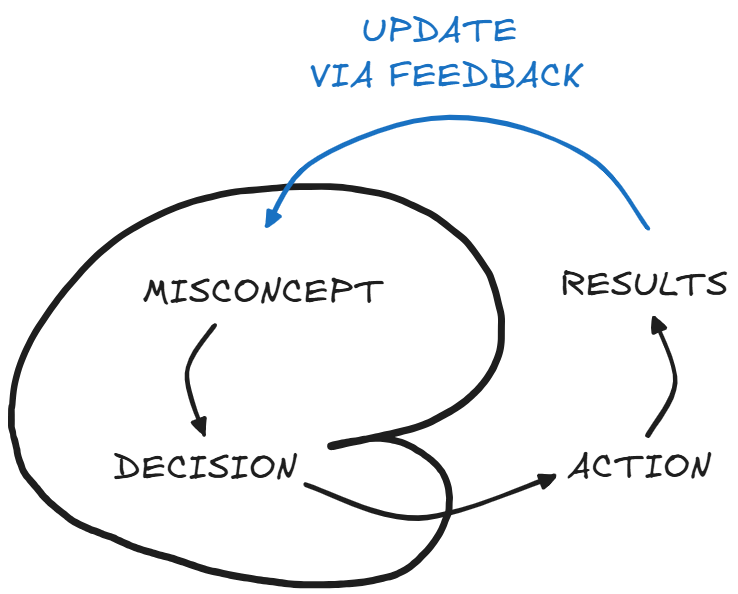
Let me show you what this looks like in practice using an example from my own life.
The pattern: I used to say yes to things I didn’t want to do because I was afraid of disappointing others. My misconcept on building relationships was based on not upsetting people which resulted in people-pleasing behaviour.
First iteration: When a friend invited me to a dinner I didn’t want to attend, I launched into excuses about my schedule, my other commitments, and why I couldn’t physically make it work.
The feedback: She started offering solutions. Different dates, different locations, different formats. I found myself making more excuses, then eventually saying yes when I ran out of plausible ones, which left me feeling resentful.
The update: This approach wasn’t building a genuine relationship. I was being inauthentic and it was exhausting. I updated my misconcept on building good relationships to include being authentic and honest about what I want, even if the other person won’t like it.
Next iteration: When another invitation came that I wanted to decline, I tried something different. I simply said, “No, thank you.” No excuses. No elaborate justifications.
The feedback: To my surprise, they said “No worries!” and moved on. No hurt feelings, no negotiation. The more I repeated this, the more my relationships improved — not because people enjoy hearing “no,” but because authenticity acts like a filter, attracting the right people while the wrong ones fall away.
This simple example also revealed something I hadn’t expected. When you’re honest about what you want, even when it disappoints, people learn your words have meaning. Your no means no. Your yes means yes. They can trust you. And they end up valuing your “yes” more because they know it’s real.
The faster you iterate, the faster you improve. Small cycles compound into big changes as what you want and what you’re actually getting start to match.
Falling in love with good iterations doesn’t just help me learn faster. It helps me use my finite mental resources more effectively.
Instead of wasting energy ruminating on past mistakes, I extract the lesson, tell myself “next iteration,” and move on. Instead of overthinking before I act, I take action sooner to get feedback faster. I get a much higher return on my limited headspace that way.
This shift has accelerated progress across every domain of my life because iterations work at every scale.
Some take seconds: You’re in a conversation and realize you’ve been planning your response instead of listening. You notice it, reset your attention, and re-engage. That’s an iteration.
Some take minutes: You notice yourself in a mental loop of worry, you bring yourself back to the present moment by redirecting your thoughts. That’s an iteration.
Some take days: You publish a piece of writing that doesn’t land the way you hoped. You read the comments, identify what didn’t work, and apply those insights to your next draft. That’s an iteration.
The practice is simple in theory but harder in practice if your default has been to avoid mistakes. Your nervous system might still spike with anxiety when something goes wrong, even as your mind knows it’s just feedback. That’s okay. Each cycle shifts your relationship with mistakes. Not just intellectually, but emotionally.
Your Next Iteration
I used to see myself as someone who needed to get things right. Now I see myself as someone who gets better through feedback. That changes everything.
The fear of making mistakes keeps you stuck.
But iterations?
They compound.
Every cycle makes you a bit sharper, a bit wiser, a bit freer.
I’m still practicing this, but I’m falling in love with good iterations because honestly? It’s the only way forward.
So here’s my question for you: Where are you currently stuck because of your fear of making mistakes? What would one iteration look like?
Start there. Try. Fail. Learn. Iterate.
If you enjoyed this deep-dive, you’ll enjoy Micro Misconcepts.
A weekly newsletter delivering mental model upgrades in under 5 minutes, designed for maximal ROI on your finite time and energy.